Manufacturing Fame: Synthetic Creators and the Architecture of Trust
Consider Fruit Love Island, a series in which anthropomorphic fruits court one another in the format of a dating reality show. It is produced entirely with artificial intelligence: images, voices, scripts. In nine days it accumulated roughly 300 million views and three million followers, becoming the most viral series in the history of TikTok, with twenty-two episodes averaging more than ten million views each. The amount it earned directly from the platform is reported to be in the region of 4,500 dollars, roughly a month of mediocre freelance work. The figure is unverified, but it indicates the order of magnitude. Half the episodes were removed following mass reporting, and after nine days of planetary visibility the creator closed the operation, in part because it was not generating income.
The episode poses the question that organises this essay, and which bears directly on the business of representing human creators: can synthetic content of this kind substitute for human content creators, and if so, in what proportion?
The problem of scale
I co-founded Flatmates, an agency that manages roughly one hundred content creators across Italy, Spain, Portugal, and the United States. They are all human, for now. The work consists in selling human fame, which by definition does not scale: human beings fall ill, age, quarrel, and leave.
The structural limitation has produced an industry response. The Spanish agency The Clueless, having tired of the imperfections of human talent, developed an influencer from nothing: Aitana López, an AI model with some 400,000 followers. The agency’s founder has stated that Aitana was created in order to stop depending “on people with egos, with manias, or who only want to make a lot of money by posing.” One need not endorse the position to recognise the reality it describes. The effectiveness of human influencers is bounded by their time and availability, and cannot scale beyond a certain threshold. The alternatives — wholly or partly computer-generated — are therefore not a curiosity but a competitive pressure with which the industry is obliged to reckon.
What a brand actually buys
When a brand commissions a video from an established creator, it acquires three distinct things bundled into a single transaction, a structure examined at length in Influence to Infrastructure. The first is the testimonial: the public figure, and the values the audience attributes to them. The second is the content: the video itself, optimised for the platform on which it is meant to perform. The third is the community: the audience that trusts the creator and can be activated, that is, amplification.
Audiences follow a creator such as Marcello Ascani for many reasons, but principally because he is human, because he appears genuine, and because his content is interesting. These three properties are habitually treated as inseparable from his humanity. The remainder of this essay examines each in turn, and asks whether it survives the algorithmic production of faceless, AI-based content. Two of the three do not.
A spectrum of decreasing humanity
It is useful to arrange the field along a single axis, from the fully human to the fully faceless, with hybrid cases in between, and to ask a second question of each position: do non-human channels generate revenue comparable to human ones?
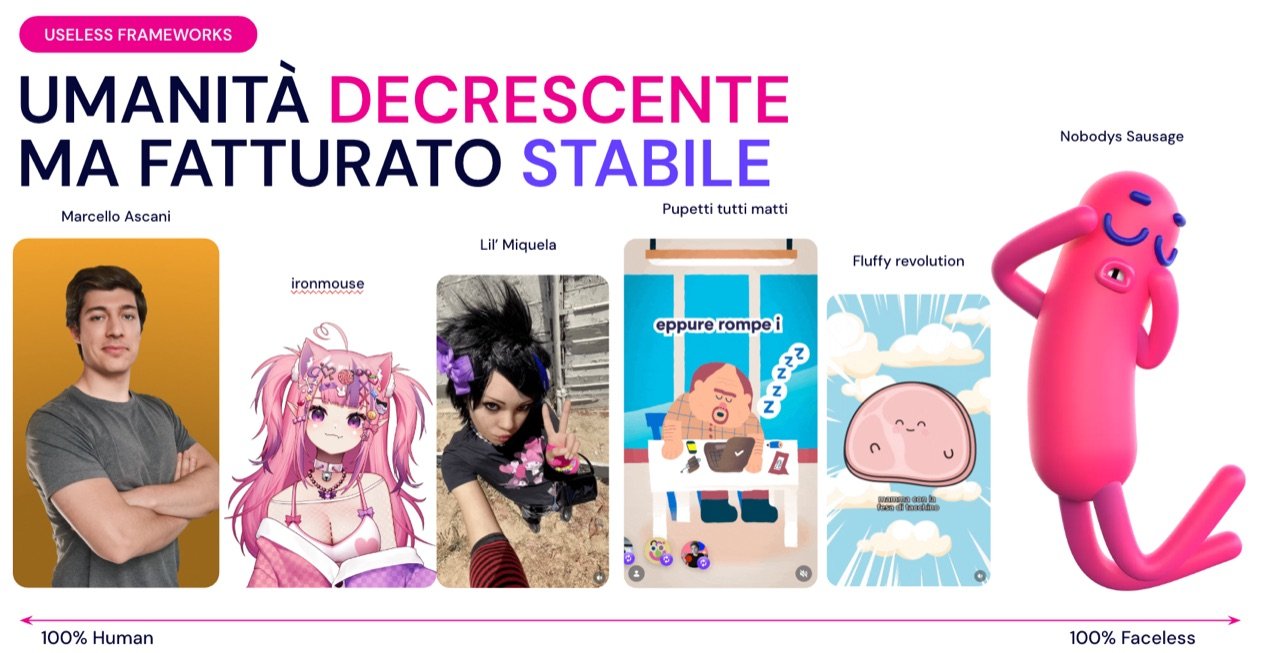
At one extreme stands the purely human creator: a person of flesh and blood who recounts what they do and what they believe. One step along is Ironmouse, the most-subscribed VTuber on Twitch: beneath a two-dimensional anime avatar there is a real person. A further step brings us to Lil Miquela, probably the best-known AI influencer in the West — a virtual creature with deliberately human features, sustained by a substantial human apparatus. She was created in 2016 by Brud, a Los Angeles startup founded by Trevor McFedries and Sara DeCou; by 2019 Brud was valued at 125 million dollars, for a CGI character with no voice, no body, and no real clients. Brud was acquired in 2022 by Dapper Labs, the company behind NBA Top Shot and CryptoKitties, with the intention of converting Miquela into a community-governed Web3 asset. That never quite happened, but the attempt prefigured the subsequent narrative of “decentralised influencers.”
Further still is Pupetti tutti matti, a faceless Instagram account driven by the unmistakable human point of view of Lorenzo Badioli. Here we depart from human appearance while retaining an intensely human and idiosyncratic communicative style. It is faceless not in the sense of anonymity but in the sense that the medium is a character rather than a person — the closest Italian case to the logic of international character-driven content, yet with a stylistic signature so recognisable that the audience knows the author without seeing him.
Fluffy revolution, created by NAM Studio, is a channel in which anthropomorphic vegetables ask to be eaten. There is no face and no disclosed author, but there is a brand, capable of partnering with companies. At the far extreme stands Nobody Sausage, a sausage modelled in 3D in 2020 by the Brazilian artist Kael Cabral. The sausage now has 22 million followers on TikTok who have no idea that Cabral exists. It has no dialogue, no narration, no language; it communicates solely through movement and exaggerated reaction. This makes it platform-agnostic and culturally neutral: it functions identically in Korea, Brazil, Italy, and the United States, without localisation.
The question the spectrum raises is simple. At each step in which humanity is removed, what is lost — and does revenue follow humanity, or is it independent of it?
Pillar one: the celebrity is already a mask
There is no necessity that the public figure coincide with a human being. Often the human, too, wears a mask.
Sometimes the mask is digital, layered over a real person. Ironmouse hides behind an animated avatar and never shows her face, which did not prevent her from becoming the most-subscribed streamer in the history of Twitch, surpassing Kai Cenat in 2024. Behind the avatar is a real person with a real illness — Common Variable Immunodeficiency — which confines her to her home, frequently attached to an oxygen supply. The internet is at once her stage and her only window onto the world. In years of streaming before millions of followers, her physical appearance has never been revealed: the 2D avatar is her sole public identity.
Sometimes the mask has no human face at all, as with Nobody Sausage. And sometimes the celebrity is not human in any respect yet earns like a genuine influencer. Lu do Magalu, mascot of the Brazilian retail giant Magazine Luiza, was born in 2003 as a digital shop assistant — and as a communications project by the agency Ogilvy. She is today the most-followed virtual influencer in the world, with estimated annual revenue around 2.5 million dollars, some 74 brand collaborations at roughly 34,000 dollars each, and a Cannes Lion to her name. Lil Miquela has worked with Prada, Calvin Klein, and Samsung; estimates of her earnings range from “10 to 12 million dollars” in earlier reporting to “74,000 dollars” in a recent analysis — an illustration of the rigour that characterises financial journalism on virtual influencers. Imma, in Japan, has run campaigns with IKEA and Porsche. Noonoouri was the first AI popstar signed by a major label, Warner Music. Francesca Giubelli, plausibly the first Italian AI influencer, was created to promote the wines of the Castelli Romani.
The principle extends to human celebrities whose persona has detached from the person. The Khaby Lame we follow on TikTok is a mask, in the manner of Arlecchino in the commedia dell’arte: audiences follow the character while knowing almost nothing of the person — not least because he famously does not speak. Carried to its conclusion, the logic operates identically for virtual or faceless characters. We can be moved, amused, and held by Nobody Sausage or Ironmouse. We know they are artefacts, and we feel for them regardless.
They are celebrities and influencers in every functional respect. There need not be a human being on the other side of the screen for our emotions to be engaged, and therefore for our choices to be influenced. The first pillar — the celebrity — is comfortably substitutable by an account with no face.
Pillar two: the content is generated by a machine
The phenomenon known as Italian Brainrot — Tralalero Tralala, Ballerina Cappuccina, the shark in Nike trainers — generated more than seven million views in a matter of days. It is called “Italian,” but no Italian made it: a synthetic voice imitates the language. It is italian sounding applied to memes; if it were food, it would be Parmesan rather than Parmigiano. While we laughed, the ownerless meme generated a planetary business: a Roblox game, Steal a Brainrot, that reached 25 million concurrent users and an estimated 11 million dollars a month, an official Fortnite licence, and, inevitably, Panini stickers. The original creators earned nothing: one was banned from TikTok, the other deleted the videos, and the value was captured by whoever registered the trademark first.
Content online must do one of two things: entertain or teach. Does teaching require a human? Probably not. There exist faceless documentary channels, intended to be watched before sleep and sometimes six hours long, generated entirely with the synthetic voice of ElevenLabs at a cost of around 60 dollars per video. The case for which public data exist is Boring History for Sleep: its author, Adavia Davis, runs seven such channels and earns 700,000 dollars a year working two hours a day, a figure Fortune verified against AdSense payouts. It is not isolated. Bandar Apna Dost, an Indian channel of generated monkeys, has 2.7 billion views and an estimated 4 million dollars a year. Kapwing counted 278 channels of pure AI slop in the top hundred of various countries, accounting for 63 billion views and roughly 117 million dollars a year in advertising. There is even a band, The Velvet Sundown, entirely AI, which reached a million monthly listeners on Spotify and an estimated 34,000 dollars of royalties in a month before anyone noticed it did not exist.
A further question is how human the content that appears human actually is. Newspaper headlines are increasingly written and tested by AI to win the search-results ranking: written by a machine, to be read by another machine. Articles, even in the established press, increasingly read as though drafted by a language model — one symptom of the broader realignment of news and creator-led information. YouTube thumbnails, including those of the largest channels, are generated and optimised by AI toward a single objective: to produce a human feeling and, finally, a click.
A recent example is instructive. Prada produced a campaign with the artist Jordan Wolfson; it is striking, and in the comments the public is convinced it is AI-generated and is duly angry, although no one has confirmed this and the artist works with CGI and puppetry rather than AI. Two lessons follow. First, audiences cannot reliably distinguish AI from computer graphics — which means high-quality artificial content can deceive, but also that a brand associated with craftsmanship must be correspondingly careful. Second, there is a diffuse negative sentiment toward machine-made content in general, to the point that some brands now declare, loudly, that they do not use AI, as a defence against backlash. In either case — information or entertainment — the content can be made by machine. It is already being made. The second pillar has fallen too.
Pillar three: the community is the only thing that holds
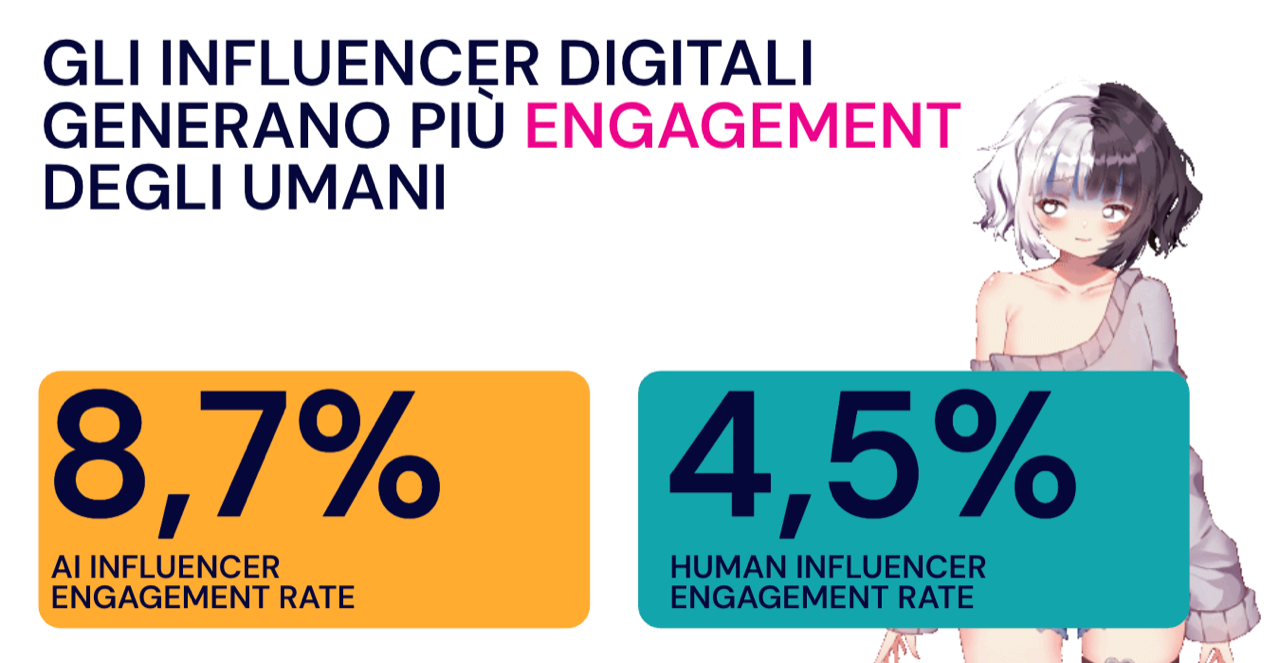
Do humans remain necessary to build genuine community? On engagement, the data say no: digital influencers reach 8.7 percent against a human average of 4.5 percent, roughly double. The leading virtual personalities sign campaigns worth more than 250,000 dollars, and there is even an AI actress, Tilly Norwood, over whom Hollywood has debated as though she were a real threat.
And yet the decisive evidence runs the other way, and it returns us to Ironmouse. Through her agency, VShojo, she had raised more than 515,000 dollars in a Twitch donation marathon for an immunodeficiency foundation. It emerged that the agency had never transferred the money. She left, launched an independent fundraiser, and in less than 24 hours passed a million dollars. Within days, twelve of the agency’s thirteen talents departed, and the agency collapsed. The followers’ trust, and their fury at its betrayal, were possible only because beneath the mask there was a human soul. Tilly Norwood can never live that arc: there is no one to betray, and therefore no one to trust. Even where AI wins on engagement, the human wins on trust. The AI community is wide; the human community is deep, and depth is the only thing that holds when matters go wrong.
Two kinds of trust
Trust is not one thing. There are two.

There is epistemic trust, trust in the content: “can I believe this?” It rests on competence, reliability, and coherence, and it is blind to the author. At times we trust the machine more, precisely because we believe it has no ulterior motive — what scholars call the machine heuristic: the machine seems neutral, without an agenda. If a fitness watch fails mid-run, one feels let down, not betrayed. To decide where to open a bank account, many would now trust a language model over a finfluencer, perceiving the former as more objective. Whether it truly is, is another matter.
Distinct from this is relational trust, trust in the person: “can I trust whoever is behind this?” It rests on accountability, vulnerability, and benevolence, and it requires one thing only: someone who is capable of betraying you. The philosopher Annette Baier captured the distinction precisely — we trust someone, but we rely on something. If the watch stops you are annoyed; if a friend runs off with your spouse you are betrayed. Only where betrayal is possible is there genuine trust. Nassim Taleb puts it more bluntly: never trust those without skin in the game, those who do not bear the weight of their own choices.
This is part of why audiences felt betrayed by Chiara Ferragni in the so-called Pandorogate affair. They would not have felt betrayed by Nobody Sausage. There is a historical trajectory here too, described by Rachel Botsman: we once trusted the people of the village (local trust), then institutions — banks, newspapers, brands — and today we trust strangers and platforms (distributed trust). In the meantime trust in institutions has collapsed while trust in creators-as-persons has risen. This is why a pure avatar will never trigger what Ironmouse triggered: deep trust requires someone who is genuinely present, and who can genuinely disappear.
Taste, status, and capital
In a framework proposed by Ana Andjelic, the creator economy uses a currency — taste — to build a particular form of capital: social status. People who share a taste are influenced by the same public figure, who is able to monetise that status. Those who follow Marcello Ascani share an outlook somewhat different from those who follow a financial educator such as Gary Stevenson. Andjelic adds an observation that recalls the countercultures of the 1990s: a decade ago the opposite of authentic influence was “selling out”; today the inversion is complete, and selling out has become the proof that one is an authentic influencer, large enough to be sought by brands.
The economics
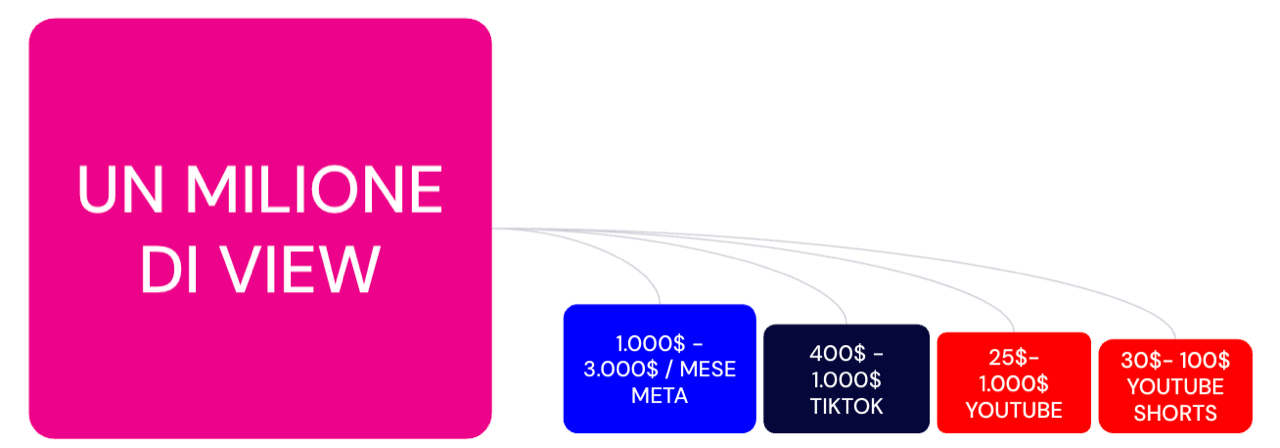
Platforms do not, in truth, pay faceless creators; they offer something closer to a grandmother’s tip. A million views is worth 400 to 1,000 dollars on TikTok, 30 to 100 on Shorts, and Meta pays its largest creators 1,000 to 3,000 dollars a month. For the largest Italian creators, AdSense rarely exceeds five percent of total revenue. The only parties who earn substantially from the platforms are those who industrialise volume, in the manner of Adavia Davis.
The paywall does considerably more. In China, paid microdramas — such as His Highness the Bichon, a soap opera with a small dog as protagonist — reach 72,000 dollars a month, and applications such as ReelShort and DramaBox have generated more than 200 and 320 million dollars respectively in a year. Virtual influencers earn through subscriptions: fifteen percent of the revenue of Fanvue, the AI equivalent of OnlyFans, comes from AI creators, Aitana included; the AI model Emily Pellegrini went from 6,000 to 23,000 dollars a month within months. Affiliation is growing fast: TikTok Shop recorded 15 billion dollars of sales in the United States alone in 2025, and the most concrete case is also the most absurd — Italian Brainrot plush toys cost two dollars on Alibaba and resell for 25 on Amazon, several thousand units a month. An entire world of AI-generated content for e-commerce is emerging, with advertising videos reportedly falling from 500 to 2 dollars apiece and campaigns turning 6,000 dollars of spend into 45,000 of revenue. These last figures come from vendors’ own blogs and should be treated with caution, but the direction is clear.
Brand deals remain the strongest flow, as ever: a campaign with a high-end virtual influencer is worth between 10,000 and 35,000 dollars per post, and six figures for a full campaign. But the brand deal rests on trust — and so, once again, we return to the third pillar.
The floor and the ceiling
The celebrity functions perfectly well as a virtual entity, and the content is generated without difficulty: two of the three rungs have already given way, and revenue has followed them down. Only the last holds: the trust of the community.
The result is a two-layer model. We can delegate the floor to the machine — the epistemic trust we place in content. To the human remains the ceiling: relational trust, which no empty avatar can earn. In what proportion does AI replace us? Two-thirds of the craft — the face and the content — are already industrialisable. The final third is not.
The genuinely new market is neither information nor entertainment. It is the market of empathy, of human relationship, of sincere trust. Here humans do not scale, but they are genuinely precious and irreplaceable — which, on reflection, is the only piece of good news for me and for the work I do, and the point toward which the argument of my book, Ogni brand è un creator, ultimately tends.
Sources
- Fruit Love Island — Wikipedia and Gizmodo — viewership, episode removals, monetisation.
- The Clueless / Aitana López — Fortune and Euronews — founder’s rationale and follower data.
- Ironmouse and VShojo — Tubefilter, Aftermath, and Kotaku — most-subscribed Twitch record, the donation scandal, and the agency’s collapse.
- Lu do Magalu — Inc. and Ogilvy — origin, revenue, and Cannes Lion.
- Lil Miquela, Imma, Noonoouri — Inc. and Designboom — Brud, valuation, brand campaigns, the Warner Music signing.
- Nobody Sausage — VirtualHumans — origins and reach.
- Italian Brainrot and Steal a Brainrot — Wikipedia and Spin Master — virality, Roblox revenue, licensing.
- Faceless channels, Adavia Davis, AI slop — Fortune and Kapwing — AdSense earnings and the count of AI channels in platform charts.
- The Velvet Sundown — Euronews — the AI band’s Spotify figures.
- AI engagement versus human — GWI, via SQ Magazine.
- Status as a Service — Eugene Wei; taste, status, and capital — Ana Andjelic.
- Trust — Annette Baier, Nassim Taleb, and Rachel Botsman; see the Stanford Encyclopedia of Philosophy entry on Trust.
- Microdrama and subscriptions — Cybernews, Sensor Tower, and Fanvue via Sacra.
- TikTok Shop and brainrot merchandising — Accio.