YouTuber or Journalist? The Business Model Behind the News
YouTube is the mainstream media now
For anyone who spends a significant portion of their time online, the observation is trivial: people no longer watch television, they consult digital sources for information, and when it comes to news they listen to the opinions of content creators with no formal training in journalism. Ten years ago this was not the case, which is why it is worth retracing how the current configuration emerged.
The inflection point: Joe Rogan refuses to fly
There is a moment that functions as a watershed in the mainstream media landscape. In October 2024, the American podcaster Joe Rogan, having just interviewed Donald Trump, was negotiating a similar appearance with the Democratic presidential candidate Kamala Harris. Her campaign proposed a Washington studio. Rogan refused in a public post on X, insisting that the interview take place in his Austin studio.
No journalist of comparable institutional standing would have refused an interview with a presidential candidate over a travel logistics issue. Rogan had the standing and the leverage to do so. The relevant question is how a figure whose career was built on YouTube came to hold more weight, and more negotiating leverage, than a senior reporter at the New York Times.
Rogan’s audience is substantial. On YouTube alone, his subscriber base is composed largely of men in the eighteen-to-thirty-five demographic, with overlapping interests in mixed martial arts, comedy, and a heterogeneous set of countercultural topics. Adding Spotify and Instagram reach, with significant overlap, the total audience scales further. His Trump interview has accumulated tens of millions of views on YouTube.
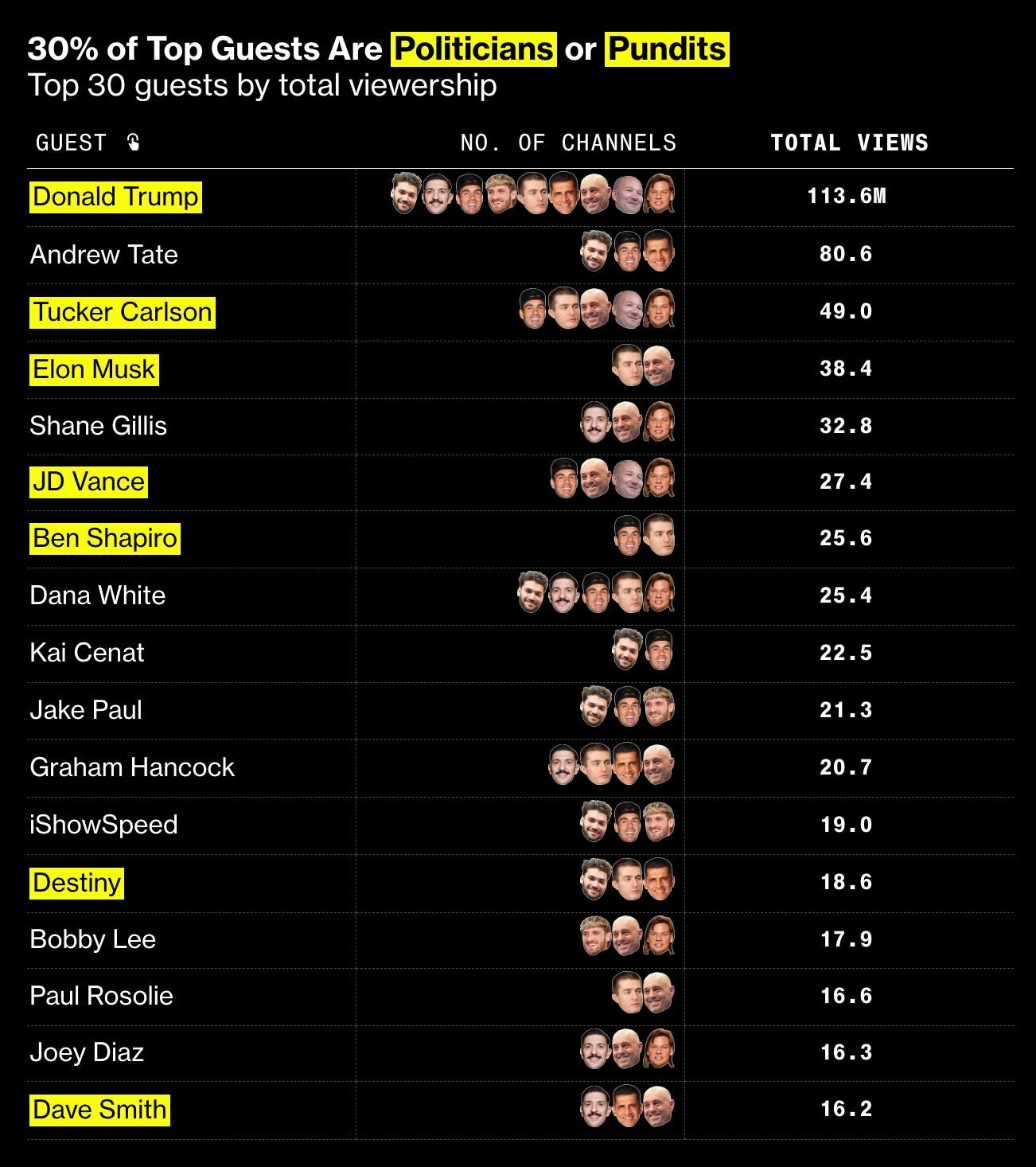
Television formats would struggle to reach comparable figures. The only political event to surpass Rogan’s Trump interview in audience size during the 2024 cycle was the Harris-Trump debate. The episode represented a structural shift. According to a Bloomberg analysis of 2,000 videos across nine prominent YouTubers, covering approximately 1,300 hours of footage, Trump appeared on all nine channels, generating more than 100 million listens across the network. Rogan’s interview alone drew approximately 50 million YouTube views.
YouTube has become a mainstream medium
The Trump-Rogan figures suggest that YouTube has, by certain metrics, become more effective than traditional television. The term “mainstream media”, once used to distinguish mass channels from niche or second-order ones, has lost much of its analytical purchase. YouTube now functions as a mainstream medium in its own right: it reaches a mass audience rapidly and pervasively, and has displaced legacy formats in terms of cultural and political relevance.
The Trump campaign’s media strategy serves as a useful test case. Candidates substantially underutilised television and print outlets, while actively seeking appearances on podcasts, engaging with YouTubers, and producing content optimised for Instagram and TikTok distribution.
The data: we now trust YouTubers more than television
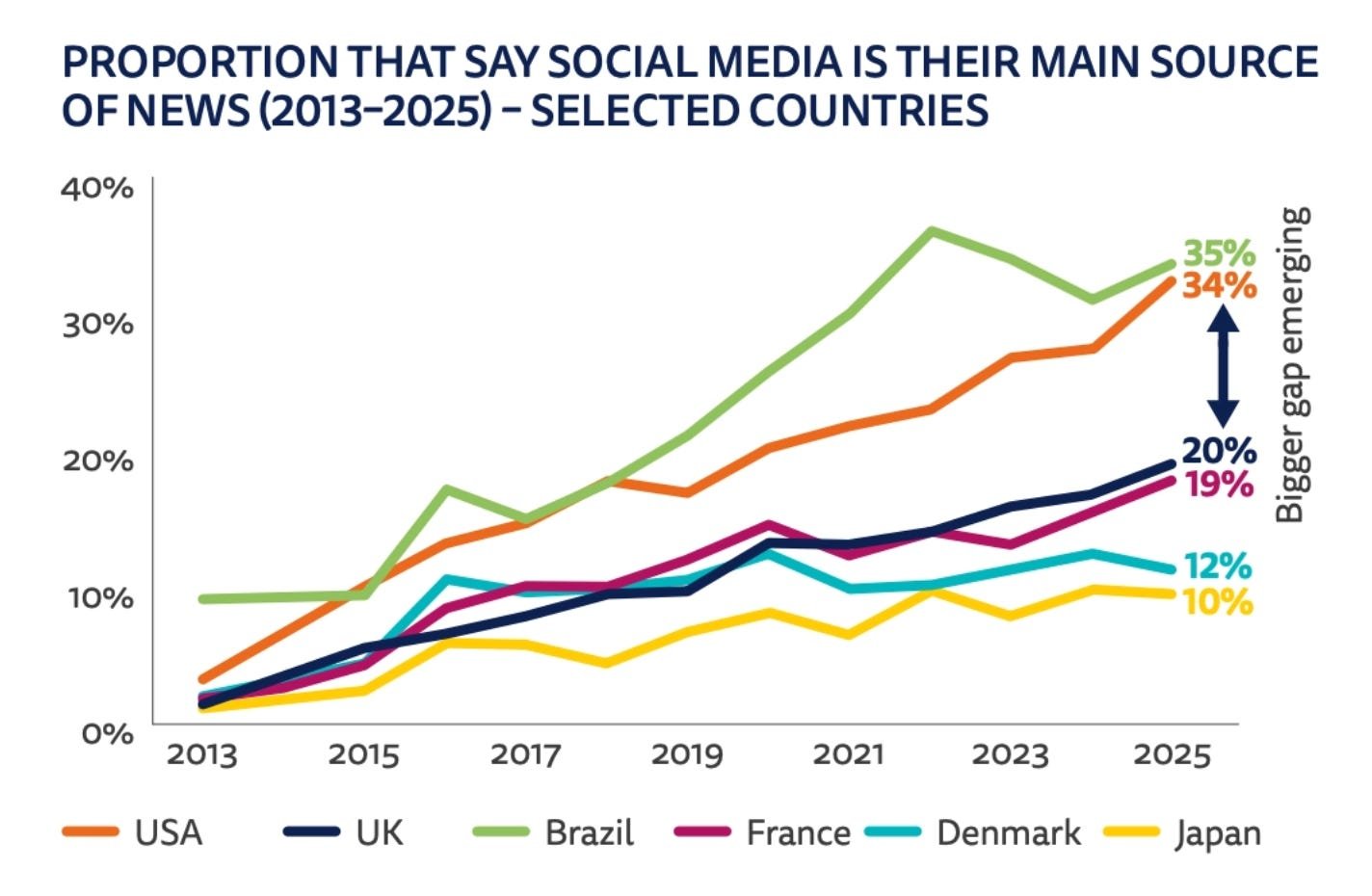
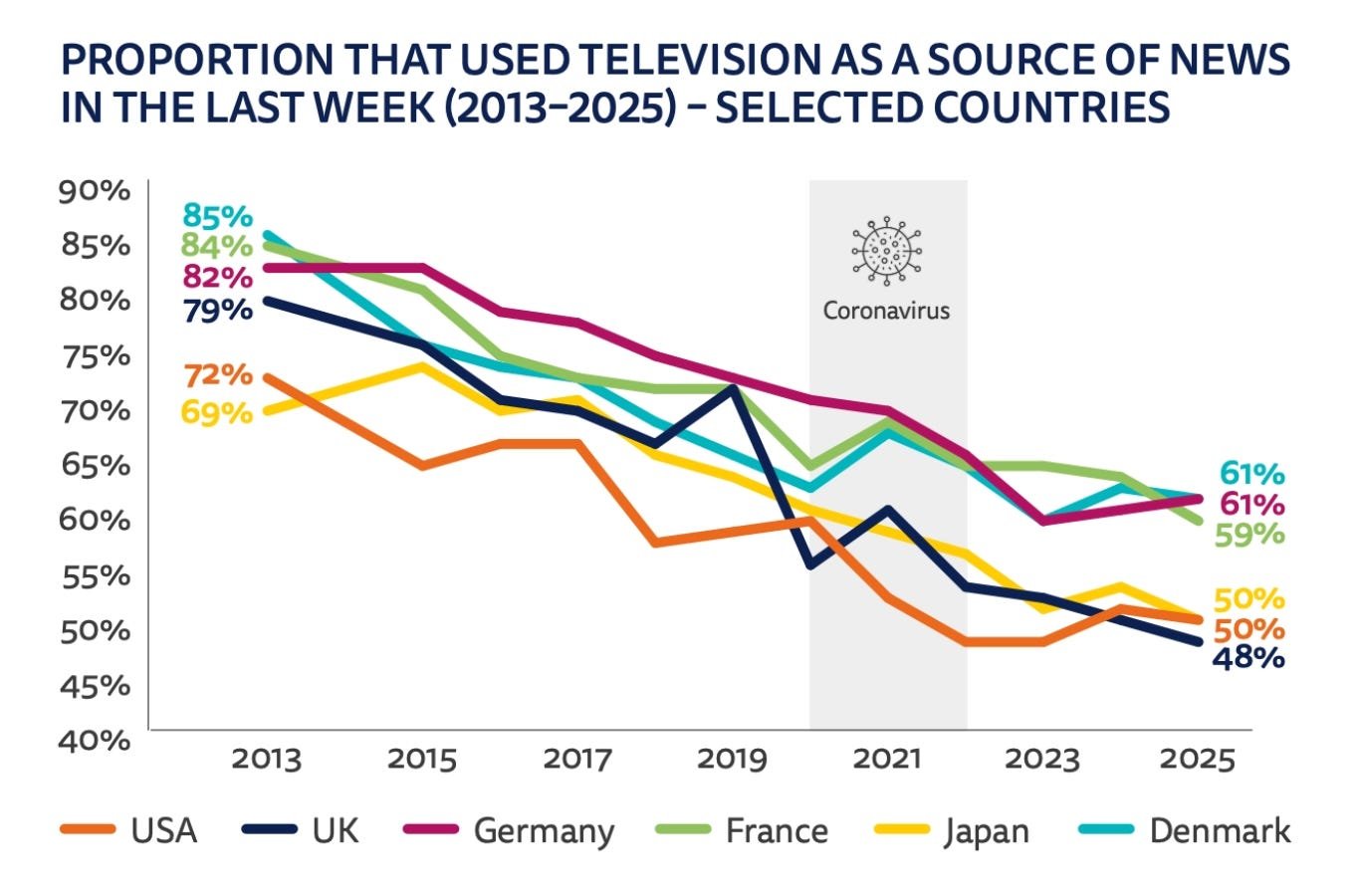
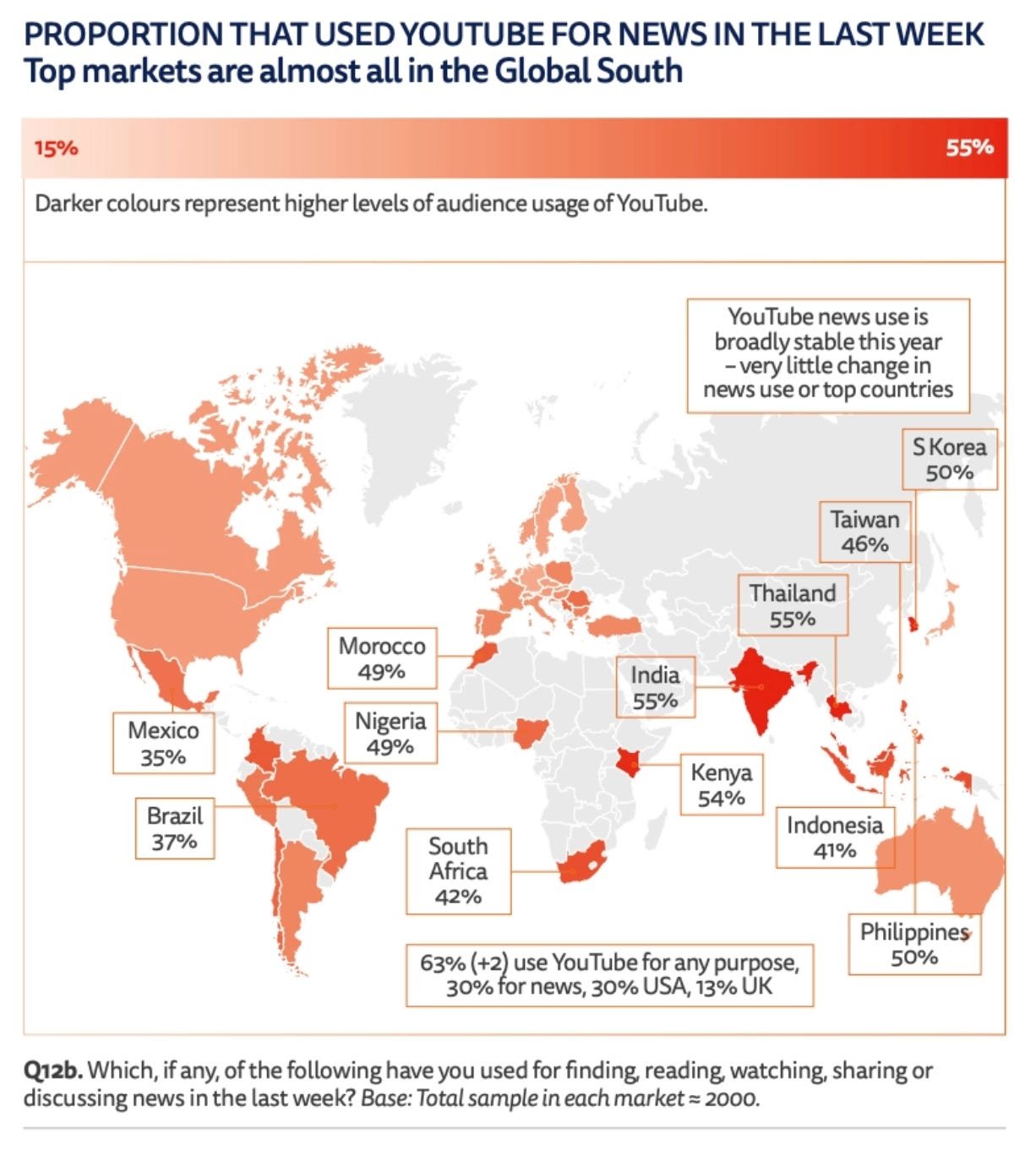
The numerical confirmation of the decline of traditional media and the rise of YouTube as a primary news source comes from the Reuters Institute Digital News Report 2025. In the United States, for the first time, more respondents report obtaining news from social media and video platforms (54%) than from television (50%) or news websites and applications (48%). The proportion accessing news via social and video platforms in the United States is up sharply, by six percentage points year-on-year. The gap between the United States and most European markets continues to widen.
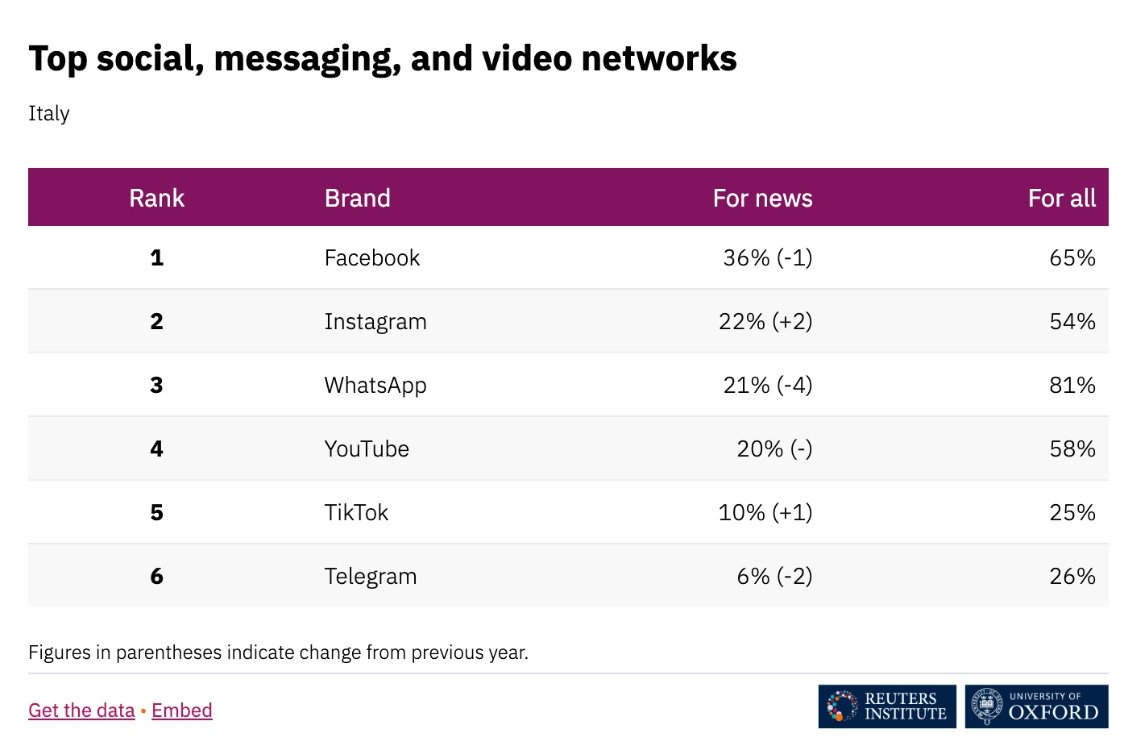
In Italy, according to the same Reuters report, trust in news overall sits at 36%, with significant portions of the population relying on social media platforms, including Facebook, for news consumption.
Why we stopped watching the evening news and reading newspapers
The first explanatory factor is the collapse of trust in traditional outlets. According to the Gallup annual trust survey, 31% of Americans express a great deal or fair amount of confidence in the media to report news fully, accurately, and fairly, while 36% express no trust at all, the highest no-trust reading in the historical series. By comparison, in three readings during the 1970s, trust ranged between 68% and 72%. The acceleration of the trust crisis traces to the COVID-19 period and is corroborated by parallel data from the Edelman Trust Barometer.
The second factor is the increasing demand for personalisation of information. Content creators perform substantially better on this dimension than traditional journalism: they translate communication into registers that are more accessible, more recognisable, and more proximate to the audience.
The third factor concerns digital platforms themselves. Users spend large fractions of their time on platforms that make information immediately accessible, but only a small minority of institutional news organisations have developed the operational competence required to function effectively on those platforms.
The structural consequences are visible in the data. According to Pew Research’s news influencer study, 77% of news influencers with more than 100,000 followers have no current or past affiliation with a news organisation. Among Americans who regularly get news from news influencers, 65% say these influencers have helped them better understand current events and civic issues. The audience is not selecting lower quality material out of laziness, or because the platforms force a choice: it is selecting a different relational model. As NPR CEO Katherine Maher has stated, “People are no longer looking for a relationship with an institution. They are looking for a relationship with a person. They want to understand why someone is saying what they are saying.”
Influencer journalists or creators who cover the news?
News sources on social media are heterogeneous. There are traditional newspapers that have built effective digital presences (a small minority), digital-first information outlets (Will, Factanza, Starting Finance, Worldy), individual journalists who have developed competence with digital tools, and content creators who comment on news and distribute their opinions on specific topics. The four categories are structurally distinct but functionally similar: they all inform audiences.
Audiences do not always distinguish between them.
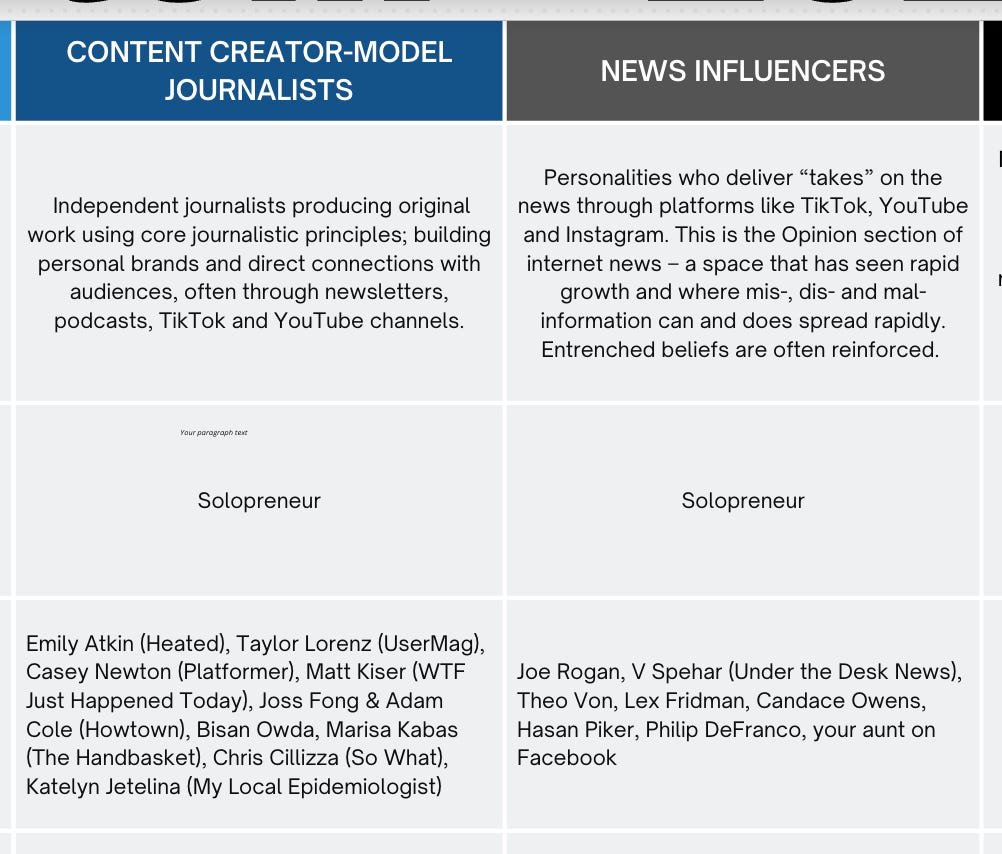
The journalist Liz Kelly Nelson has mapped the full taxonomy of digital journalism in a detailed diagram titled The News Ecosystem, and has insisted on the distinction between content-creator model journalists and news influencers.
Content-creator model journalists versus news influencers
Content-creator model journalists are independent journalists, typically credentialed within professional journalist registers, who produce original investigations applying traditional methodological principles. They conduct primary research, verify sources, write detailed articles, and invest in their credibility as a long-term asset. In addition, they understand how to use digital tools to reach niche audiences and adopt the business model characteristic of content creators.
Examples include Taylor Lorenz, who covers technology and platforms, and Bisan Owda, who reports from Gaza. Their income comes primarily through paywalls on Substack, Patreon, or comparable platforms. In Italy, Selvaggia Lucarelli fits the category, although she explicitly rejects the journalist label. Cecilia Sala is another relevant Italian example.
News influencers, by contrast, are not journalists in any meaningful sense. They are content creators with strong opinions on specific topics, capable of building large communities. Liz Kelly Nelson defines them as the editorial pages of the internet. They communicate primarily through TikTok, YouTube, and Instagram, and frequently do not adhere to traditional journalistic principles. In some cases, they function as distribution channels for low-quality information. Their business model is based on platform monetisation and brand partnerships.
Joe Rogan and Lex Fridman are the canonical examples. In Italy, the Fabrizio Corona YouTube channel, with one million subscribers and a significant paying subset, fits the category. Pulp, the podcast co-hosted by Fedez and Mr Marra, occupies the same space, as do more respected practitioners such as Alessandro Masala of Breaking Italy.
To clarify the distinction, I asked the journalist Marco Bardazzi for his view of the difference between a journalist and a content creator. His response is worth quoting at length.
The figures of the journalist and the content creator are destined to integrate progressively and become interchangeable. Today, I see the difference less in formal terms (professional registers, deontology, contractual frameworks) and more as a question of method. Journalism is a team game with rules constructed over the past three centuries, and participation in a well-defined intellectual community with its own method of representing reality. Even when journalism is practised alone, as with freelancers, the destination is almost always an organisation. Whether newspapers, radio, or television networks, journalism follows a trajectory that has been built and codified over time, with its own university programmes and its written and unwritten rules.
The world of content creators, by contrast, is currently in a phase of creative magma, in which everyone invents their own trajectory, and in which the rules, where they exist, are tied more to the technology of the platforms than to the modalities of storytelling. There are rules of the container but not of the content. This grants substantial freedom to content creators and makes them promising agents for the renewal of journalism. It will be interesting to observe how the two paths gradually converge into something genuinely new.
The convergence trajectory that Bardazzi identifies is valuable.
Several structural movements are visible. Traditional newspapers are losing ground on multiple dimensions, including credibility, revenue, and cultural relevance, and they are accordingly attempting to absorb some of the operational modalities of content creators. The Economist, for example, has begun showing the faces of its journalists, something it had historically never done. Audiences struggle to distinguish between journalists and news influencers, because the distinction is genuinely subtle. Newspapers, however, have always constructed complex editorial structures that protect their journalists legally and financially, and arguably also protect the public. Content-creator model journalists and news influencers are building an alternative to newspapers, but in order to sustain it they will have to begin behaving in some ways like newspapers, as Bardazzi suggests. The convergence appears to be running in both directions.
Not a moral problem, a business model problem
Public debate on the journalist-versus-creator distinction tends to centre on credibility, professional ethics, and source verification. The framing functions, in practice, to protect a declining information model more than to clarify the dynamics in play.
The more interesting question, and the one that bears more directly on my work and on Flatmates, is who pays for information, and why.
The product is approximately the same: information. What has changed dramatically over the past two decades is the underlying business model, and the change has not followed a linear trajectory.
Cash rules everything around me
A staff journalist at a traditional outlet and a creator-news producer ostensibly perform the same task: they collect information, process it, and distribute it to an audience. The finished product, whether a video, an article, or a podcast, is often difficult to distinguish on its face.
The underlying economic structure, however, is radically different, and that structure determines the content.
The traditional journalist is an employee or contractor of a media organisation, and their income is decoupled from audience size. They receive compensation independently of the readership of any individual article. The payers are advertisers, or readers who subscribe to the publication as a whole rather than to a specific journalist. The journalist reports editorially to a newsroom, which reports to a publisher, which reports to shareholders or advertisers. The audience is the medium, not the customer. Frequently the journalist does not know how many views an individual article receives and, in many cases, deliberately avoids the information. If an article goes viral, the journalist does not capture any additional revenue.
The creator is, by contrast, a company of one. Their income is directly linked to audience: if audiences disengage, income stops. Brand deals, subscriptions, affiliate revenues, sponsored content: all of these depend on the direct relationship with the audience. Editorially, the creator answers only to themselves, but under a constraint more binding than any editor-in-chief: the immediate and quantified feedback of the community.
In the United States more than in Italy, AdSense revenues, generated directly by YouTube, are substantial. A heavily consumed podcast episode generates significant direct revenue. The longer the episode, the more advertising it can host, the more revenue it produces. This structural fact explains, in part, the prevalence of four-hour podcast episodes among American creators such as Lex Fridman.
This structural difference in business models produces divergent incentives on every individual editorial decision.
Case study: Selvaggia Lucarelli
Selvaggia Lucarelli, who is not politically right-leaning but represents the most analytically relevant Italian case of a creator-model journalist with a documented and replicable economic model, is a useful illustration.
Vale Tutto, her Substack newsletter, has surpassed 211,000 subscribers as of the most recent available data, up from 144,000 in June 2025. Within one year of its July 2024 launch, the newsletter became the leading Substack publication globally in the culture category. Lucarelli has confirmed that the conversion rate of paying subscribers is substantially above 10%.
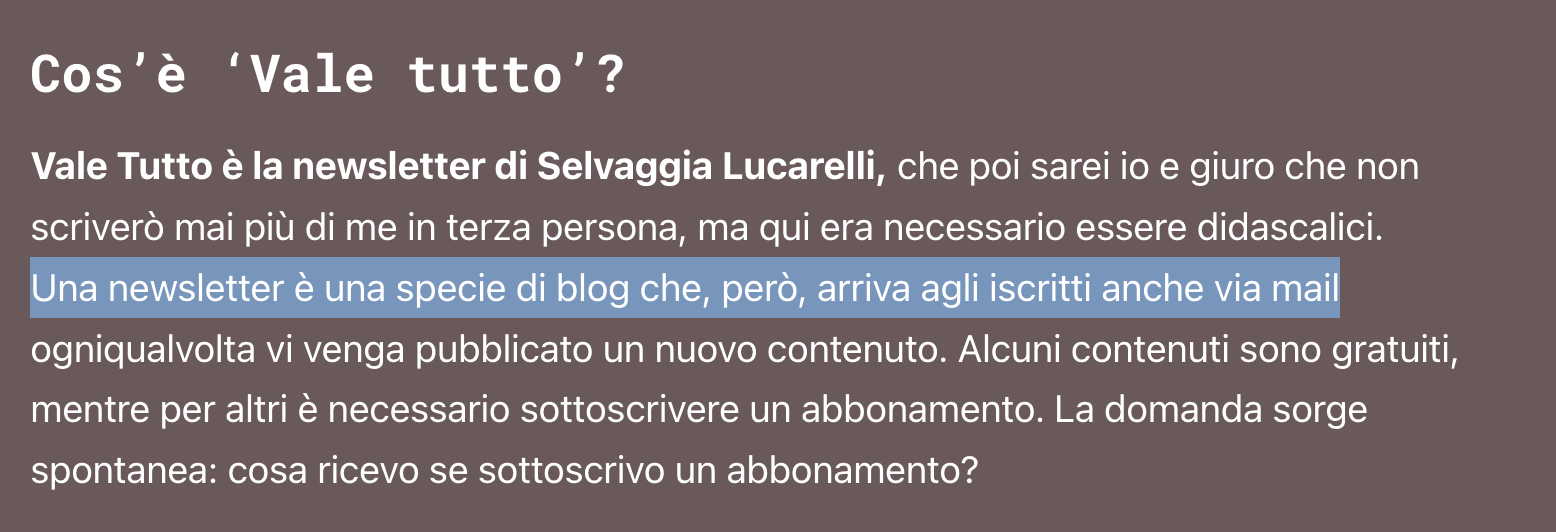
The subscription costs 7 euros per month or 70 euros per year. Under a conservative estimate of 15,000 paying subscribers, the newsletter would generate approximately 1 million euros in gross annual revenue, before Substack commission (10%) and payment processing fees.
Boutade srl, the company founded with her partner Lorenzo Biagiarelli, recorded 380,000 euros in revenue and 200,000 euros in net profit in 2024. The newsletter launched only in July 2024, so these figures do not yet capture the full operating profile.
Lucarelli has explicitly rejected the journalist label in favour of the creator label, stating: “We are in the era of the personal brand expanding into journalism. Newspapers should place more value on recognisable bylines.”
The implication for this business model is that a single newsletter can generate, or lose, thousands of subscribers in a short window. Taylor Lorenz, a technology journalist with a long-standing critical stance towards Republican positions, has documented how a reportage critical of Democratic influencer strategy cost her thousands of paying subscribers, and accordingly put pressure on her economic sustainability.
What journalists are still for
The creator model has a structural blind spot: it does not finance work that does not convert.
A six-month investigation into a municipal procurement process in a city of 80,000 inhabitants does not generate views. A provincial corruption trial has no pre-existing audience. A whistleblower needs legal protections that an individual creator cannot provide. A YouTube channel focused on entertainment will not send a reporter to Iran to verify claims made by political leaders.
These categories of content exist only if someone finances them, whether through subscriptions to a publication, foundations, or public funding. There must be a structure that decouples the cost of production from immediate economic return.
Meloni on Pulp: a relevant case
The week’s most discussed Italian event in this domain was Giorgia Meloni’s appearance on the Pulp podcast. The interesting framing is not the political content but the institutional one: Meloni is the first Italian Prime Minister to communicate through a podcast on YouTube. A detailed analysis by Matteo Flora on Narrative Governance is worth reading.
Several observations follow. The event acknowledges the effectiveness of the medium, both in terms of reach (audiences not addressed by traditional channels) and in terms of efficacy (the Pulp audience overlaps minimally with the television audience). Tommaso Longobardi, the digital communications head for the Italian premiership, framed the appearance in populist terms, arguing that it removes information from the hands of a restricted circle. The framing is accurate in a literal sense: the appearance bypasses traditional editorial filters and routes the content through new filters that operate under different conventions.
Podcasts such as the Rogan interview with Trump or the Pulp interview with Meloni are not contexts for adversarial questioning. They are largely uninterrupted monologues guided by a limited set of questions, without debate and without fact-checking. The format is appealing to political figures precisely for this reason.
The performance metrics on the original YouTube video will be strong, but the more substantial reach derives from the clips that proliferate across other platforms, decontextualised from the original conversation. Podcasts and creator collaborations enable political figures to reach new audiences complementary to their own. Proprietary channels allow direct engagement with existing audiences without any filter. Meloni’s own channels are particularly powerful in this respect, given that she holds the largest political audience in Italy and the largest Italian account in the over-45 demographic.
A final layer is the meta-narrative, that is, the proliferation of analyses by content creators of all sizes and political orientations, including this one. The Pulp podcast, despite its claims to neutrality, has a documented history of friendly relationships with right-leaning political figures, from Maurizio Gasparri (who subsequently invited Fedez to the Fratelli d’Italia convention) to Roberto Vannacci.
Is YouTube right-wing and Instagram left-wing?
The headline is deliberately clickbait, but the underlying question is non-trivial.
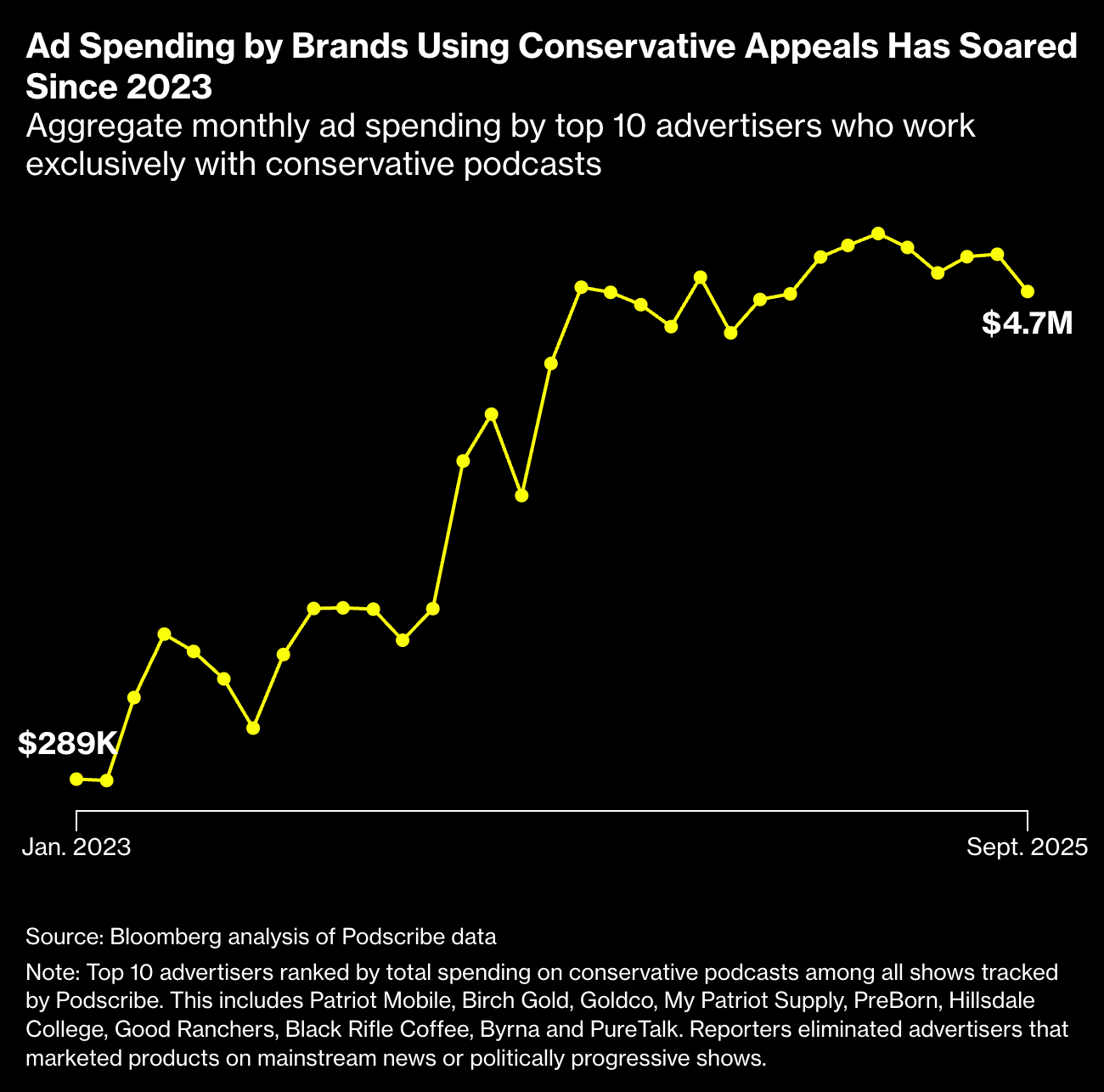
A Bloomberg investigation on the economic ecosystem of conservative podcasters is the most rigorous available work on the subject. Bloomberg analysed two years of episodes from nine YouTube channels including Rogan, Nelk Boys, Theo Von, and Shawn Ryan, and documented how these podcasters and YouTubers transformed young men, historically an apolitical demographic, into a compact electoral bloc. A subsequent Bloomberg report, published in November 2025, analysed 876 videos released between January and September 2025 and found that approximately one-third of all identified advertisers used explicit political or cultural identity appeals in their messaging, an advertising ecosystem that the political left has not yet replicated at comparable scale.
The observation that YouTube hosts a predominant share of right-leaning content creators may be a simplification. The platform is structurally open to all political orientations, but two factors deserve attention.
First, the political left has historically struggled to use digital tools with the same effectiveness, and to deploy the aggressive humour and ironic registers that perform well on the platforms. The more measured tone characteristic of Democratic communication tends to underperform on social platforms compared with the more inflammatory register of the American alt-right. This dynamic likely contributes to the perceived underrepresentation of left-leaning YouTubers.
Second, the platforms themselves are not neutral infrastructure. Most digital tools currently in use are developed in the United States, in a specific geographic area characterised by strong capital concentration. This may have downstream effects on what content succeeds on the platforms.
On Instagram, by contrast, the visible content tends to include numerous left-leaning and progressive creators, though this observation may reflect the bubble effect of personalised algorithmic feeds.
In this context, a recent investigation by IRPI Media and Wired Italia is worth noting. The investigation surfaced a media outlet called Esperia Italia, an editorial project that presents itself as an aggregator of independent sovereigntist influencers. According to IRPI, the outlet operates as an instrument of public opinion shaping, embedded within a pre-existing network of political, media, and institutional relationships connected to the conservative and governmental ecosystem. Among the founding shareholders is the partner of Tommaso Longobardi, the digital head of the Meloni premiership.
The content is engineered for virality and frequently amplifies critical positions toward left-leaning political figures. The content would perform effectively even without amplification from right-leaning politicians, who in any case amplify it consistently. The Esperia business model is subscription-based, with four membership tiers ranging from 50 to 3,000 euros annually, depending on the level of access desired, from newsletter-only access to front-row events.
How can we operate effectively in the new environment?
We grew up in a media environment in which information was firmly in the hands of institutional filters, well-structured and with transparent political orientations.
Over the past two decades, the configuration has changed rapidly and substantially.
As citizens, as users, and as professionals in the sector, we need to develop the analytical antibodies required by the new environment, which is no longer particularly new. The core skill is the capacity to understand the underlying business models, to identify who pays for the content we consume, and to engage with information with appropriate awareness of these incentive structures.
Sources
- Joe Rogan on X, 29 October 2024 — Public statement on the Harris campaign negotiation.
- Bloomberg, “How 9 Popular YouTubers Helped Trump Win a Second Term” (January 2025) — Analysis of 2,000+ videos and 1,300 hours of footage from nine podcasters; source for 100M+ combined listens, 50M views on Rogan-Trump episode, advertising analysis of 876 videos.
- Reuters Institute, Digital News Report 2025 — Source for US social/video at 54% overtaking TV (50%) and news sites (48%) for the first time, with a +6 percentage point year-on-year increase.
- Reuters Institute, Digital News Report 2025 - Italy — Source for Italy news trust at 36% and platform breakdown.
- Gallup, “Americans’ Trust in Media Remains at Trend Low” (October 2024) — Source for 31% trust / 36% no trust at all in mass media; historical comparison to 1970s readings of 68-72%.
- Pew Research, “Influencers Who Often Post About News, and Who Sees Their Content” (November 2024) — Source for 77% of news influencers without news organisation affiliation; 65% of audience finding them helpful.
- Liz Kelly Nelson, “The News Ecosystem” — Taxonomy of digital journalism categories.
- Matteo Flora, “Giorgia Meloni a Pulp Podcast: anatomia di una masterclass” (March 2026) — Analysis of the Meloni-Pulp appearance through the Narrative Governance framework.
- IRPI Media / Wired Italia, investigation on Esperia Italia — Investigation on Esperia’s institutional and political network.
- Selvaggia Lucarelli, Vale Tutto (Substack) — Reference subscription publication for the Italian creator-model journalist case study.